
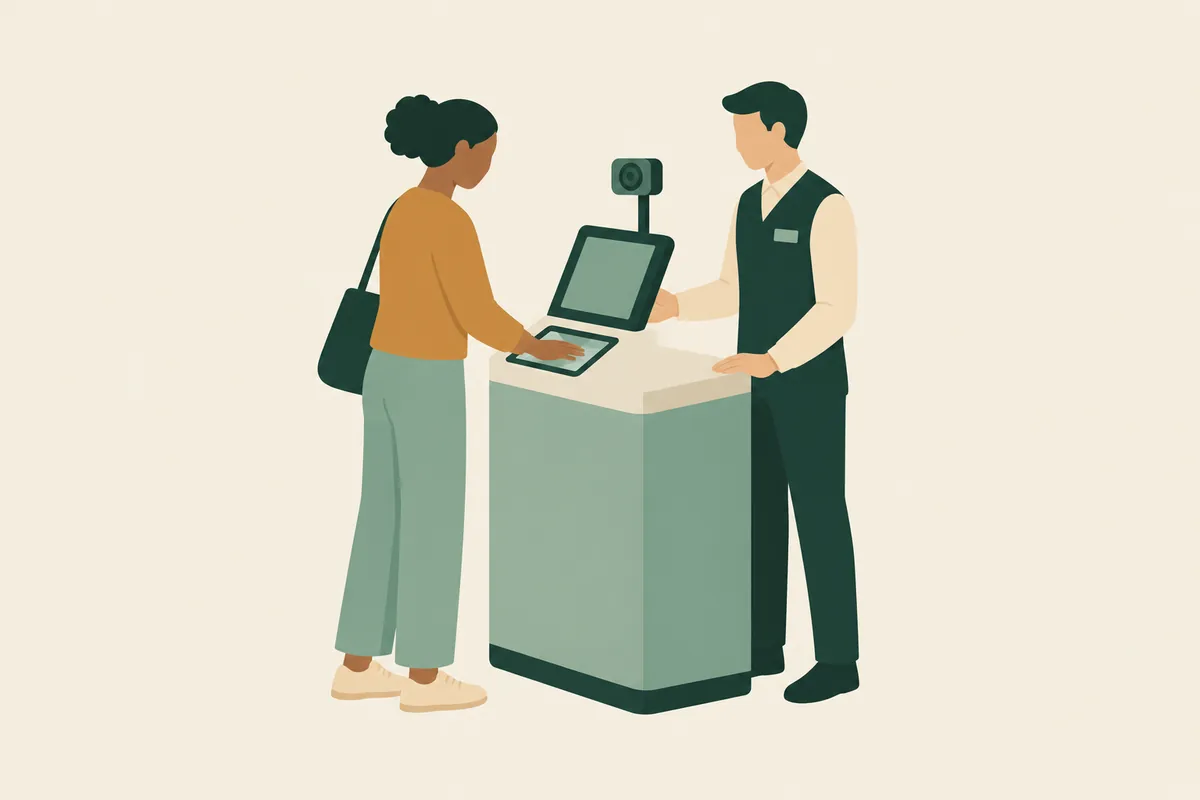
Biometrics for a 482 visa are a digital photograph of the face and a scan of all 10 fingertips, and a 482 applicant gives them only when the Department of Home Affairs asks. The request says where to go: an Australian Biometrics Collection Centre run by VFS Global outside Australia, the Australian Immi App if Home Affairs says you are eligible, or an in-person appointment inside Australia (Home Affairs biometrics page). The first step is to read the request, book the appointment it names before its deadline, and take the passport linked to the 482 application.
| Your situation | Where you give biometrics | How you book | What to bring | Deadline | Fee |
|---|---|---|---|---|---|
| Applied outside Australia and still outside | An Australian Biometrics Collection Centre run by VFS Global, possibly in another country; or the Australian Immi App if Home Affairs says you are eligible | Appointment with VFS Global | The passport linked to the application | The date in the request letter | A service fee charged by the centre (amount not published by Home Affairs) |
| Applied in Australia | An in-person appointment; collection is by appointment only | Home Affairs sends a letter or invitation | The appointment letter and the original passport, or another accepted document (Certificate of Identity, ImmiCard, UNHCR identity card, Convention Travel Document) | The date in the request | Not published |
| Applied outside Australia, now in Australia | As the overseas office directs; you may need to travel to a centre outside Australia | Tell the overseas office, through the Global Service Centre, that you are in Australia | The passport linked to the application | The date in the request | Not published |
| A child, or a person who cannot understand what biometrics are for | The same places | The same booking | The same documents; a parent or guardian must attend | The same | The same |
Who must give biometrics?
Only an applicant Home Affairs asks. The Home Affairs Core Skills stream page says: “We might ask for biometrics (fingerprints and photo). We will let you know if you need to provide them.” Home Affairs does not publish a current list of the 482 nationalities or applicants who must give them, and anyone in the application can be asked, including a partner or child applying with the main applicant. The legal basis is the power to require “personal identifiers” under the Migration Act 1958 and the Migration Regulations 1994.
Biometrics and the health examination are separate requests
A health examination is arranged separately: inside Australia through Bupa Medical Visa Services, and outside Australia through a panel physician (Home Affairs, Arrange your health examinations). A request for one does not replace the other, so a worker asked for both books the biometrics appointment and, in Australia, the Bupa visa medical as two separate appointments.
Where do you give them?
The request names one of three places:
- An Australian Biometrics Collection Centre, run by VFS Global, for applicants outside Australia. Some applicants have to travel to another country to reach one.
- The Australian Immi App, for applicants outside Australia whom Home Affairs tells they are eligible.
- An in-person appointment in Australia, for applicants in Australia. Collection is by appointment only.
At the appointment, the Home Affairs biometrics page (updated 24 September 2026) describes what happens:
- the face is photographed from below the chin to above the eyebrows, with both cheeks and ears visible;
- all 10 fingertips are scanned, and if a finger is missing, the others are scanned;
- glasses or a religious head covering may need to be removed, and collection can then be done in private by someone of the same gender;
- the travel document linked to the application has to be shown, or the centre generally will not collect.
The Home Affairs list of collection centre locations is dated March 2026, and some locations are pop-up sites with reduced hours.
What is the biometrics deadline?
The deadline is the one written in the request; Home Affairs does not publish a single standard period. A temporary injury to the face or fingers justifies a written request for more time, uploaded to ImmiAccount with the reasons, according to the Home Affairs biometrics page. If a requirement to give personal identifiers made for that purpose is not met, the visa application is invalid under section 46(2A) of the Migration Act 1958, and section 40(3) lets the Regulations make giving them a condition of grant.
Time limit
Book the appointment as soon as the request arrives. If the date in it cannot be met, upload a written request for more time, with the reasons, to ImmiAccount before that date passes.
An Australian migration lawyer makes a missed deadline less likely because they track the biometrics request alongside the health and police requests on the same 482 file and, when an injury, travel or a closed collection centre makes the date impossible, put a written request for more time on the file before the deadline, which the Home Affairs guidance allows.
Finding the request in ImmiAccount
- Open the application in ImmiAccount and read its correspondence; the biometrics request sits there with the date to meet.
- If an authorised recipient is appointed (your lawyer can be named as one), the request goes to them and counts as received by you, so ask them for it.
- Book the appointment the request names, and keep the booking confirmation.
How applications and letters are organised in the account is explained in ImmiAccount for 482 sponsors and applicants.
Does giving biometrics mean the visa is approved?
No. Biometrics confirm identity and can be checked with other agencies against identity, criminal-history and immigration records. The decision on the 482 comes later, in writing, and it needs an approved nomination first.
What do biometrics cost?
Home Affairs does not publish the amount. The collection centre charges a service fee, and the Home Affairs Core Skills stream page lists biometrics among the costs that are not included in the visa application charge, alongside English tests, health checks and police certificates.
Supplementary: the document checklist, and what a missed request can lead to
Biometrics sit alongside health examinations and police certificates as requests made while the application is processed, and each has its own date. The full subclass 482 visa document checklist shows where they fit among the documents uploaded at lodgement. A missed request leaves the application open to being invalid or refused. If it ends in a refusal, the guide to a 482 visa rejected sets out the review options and the time limit.
Questions people ask
Where can I do biometrics for an Australian visa?
Outside Australia, at an Australian Biometrics Collection Centre run by VFS Global, or through the Australian Immi App if Home Affairs says you are eligible. Inside Australia, at the appointment Home Affairs gives you.
Do I need to do biometrics for an Australian visa?
Only if Home Affairs asks. The 482 stream pages say it might ask for biometrics and will tell you if you need to provide them.
Does giving biometrics mean my visa is approved?
No. Biometrics confirm your identity, and the decision on the visa comes later, in writing.
How much does biometrics cost for an Australian visa?
Collection centres charge a service fee that Home Affairs does not publish. It is paid separately from the visa application charge.
Can I give biometrics online?
Some applicants outside Australia can give their biometrics through the Australian Immi App, but only if Home Affairs tells them they are eligible. Everyone else attends a collection centre or an appointment.